


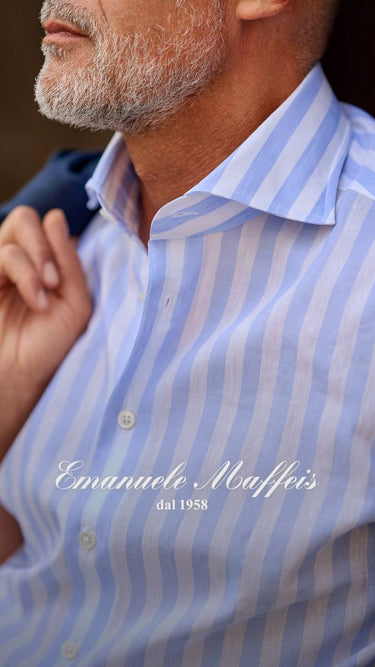
A great shirt doesn’t shout; it fits, frames, and quietly upgrades everything around it. If you’re considering an Italian shirt and want the clarity to choose once and wear often, this Emanuele Maffeis size guide distills what matters—how to read measurements, what affects drape, and where tailoring actually pays off. No fluff, just practical cues you can use the moment you pick up a tape measure.
Emanuele Maffeis comes from Bergamo, a region known for rigorous pattern-making and clean, unfussy lines. That DNA shows in how the yoke sits, how the sleeve rotates as you move, and how the collar behaves open-necked or with a tie. Below you’ll find an Emanuele Maffeis measurements chart (indicative, because fabrics and models vary), plus Italian shirt fit tips drawn from real fittings, not theory.
The Emanuele Maffeis measurements chart (indicative ranges)
Before the details, two notes. First, true Italian shirting is built around balance—neck, yoke, and sleeve must agree or the chest will misbehave. Second, numbers below describe body-target ranges for a close-but-comfortable look; actual garment specs vary by model, fabric weight, and intended ease. Use them as a compass, then fine-tune on the product page and during try-on.
|
Tagged Collar (EU / in) |
Target Chest (body) |
Target Waist (body) |
Sleeve length (cm / in) |
Yoke/Shoulders (cm / in) |
|
38 / 15.0 |
94–98 cm (37–38.5 in) |
80–84 cm (31.5–33 in) |
63–64 / 24.8–25.2 |
44–45 / 17.3–17.7 |
|
39 / 15.5 |
98–102 cm (38.5–40 in) |
84–88 cm (33–34.5 in) |
64–65 / 25.2–25.6 |
45–46 / 17.7–18.1 |
|
40 / 15.75 |
102–106 cm (40–41.5 in) |
88–92 cm (34.5–36 in) |
65–66 / 25.6–26.0 |
46–47 / 18.1–18.5 |
|
41 / 16.0 |
106–110 cm (41.5–43.3 in) |
92–96 cm (36–37.5 in) |
66–67 / 26.0–26.4 |
47–48 / 18.5–18.9 |
|
42 / 16.5 |
110–114 cm (43.3–44.9 in) |
96–100 cm (37.5–39.5 in) |
67–68 / 26.4–26.8 |
48–49 / 18.9–19.3 |
Treat the table as a starting point, especially for sleeve length and yoke measurement. If you sit between sizes, prioritize collar comfort and shoulder accuracy; waist can be tapered later without drama.
How to measure for dress shirts the right way
Start with a shirt you already like and measure flat on a table. For the collar, close the top button and measure the inner circumference—this is the tagged size in centimeters in Italian systems (38, 39, 40, etc.). For the yoke, run the tape from seam to seam straight across the back; that distance translates into how the sleeves hang and how the upper back feels when you reach forward. For the sleeve, measure from shoulder seam to end of cuff; note that posture, arm rotation, and watch size change what feels “right” by a half-centimeter. Chest and waist are best taken on your body: tape parallel to the floor, a natural breath, no bravado. The goal isn’t the smallest number; it’s repeatable comfort in real life.
Bergamo shirtmaker sizing: what sets the pattern apart
Bergamo tailoring loves clarity. In practice that means a yoke that stays level, sleeves pitched to match a natural resting stance, and a collar that reads clean whether you wear it open or under a blazer. The result is a shirt that looks neat in stillness and moves without pulling when the day gets busy. If Neapolitan makers often trade on softness and roll, Bergamo’s signature is composure: the line stays tidy, the placket doesn’t wave, the cuff meets the watch without fuss. That’s why Bergamo shirtmaker sizing can feel more “exact”—not tight, just decisively mapped to the body.
Italian shirt fit tips that work outside the fitting room
Think in zones. The collar frames your face, the yoke governs movement, the sleeve sets the rhythm, and the waist polishes the silhouette. If the collar pinches, the day is lost, no matter how good the rest looks. If the yoke is too narrow, the sleeve binds and the chest ripples; too wide, and the shirt collapses off the shoulders. Waist shaping is a style choice, but it must be honest about your habits—if you sit often, a moderate taper will look sharper by evening than an aggressive one that buckles at the belt. When in doubt, choose clean over skinny; air between cloth and skin is what makes a premium shirt read expensive.
Sleeve length and yoke measurement, decoded
A precise sleeve ends at the wrist bone with your arms relaxed. If you wear a substantial watch, consider a whisper more length on that side or a cuff configuration that buys clearance. The yoke is your steering wheel: 1 cm too narrow and your reach will tug the placket open; 1 cm too wide and the sleeve seam creeps down the deltoid, dulling the silhouette. Because the sleeve head is eased into the armhole, tiny shifts in yoke measurement change how the sleeve rotates as you type, drive, or shake hands. That’s why a good Emanuele Maffeis size guide always treats yoke and sleeve together, not as isolated numbers.
Slim vs classic fit shirts: who should wear what
Slim fit is not a synonym for style; it’s a proportion. If your shoulders are broader than your midsection, a gentle waist shape cleans the profile without turning the shirt into a jersey. If your chest and waist are closer in measure, classic fit respects your outline and looks smarter than a forced taper. Italian patterns usually cut the armhole a touch higher than mainstream brands to keep the jacket tidy; paired with a modest waist, that creates an athletic impression without squeezing. Read the mirror at 1–2 meters, not just the size tag: Does the side seam fall straight? Do the back darts lie flat? Do you see cloth, not tension?
Collars, cuffs, and the small decisions that decide the fit
Spread and semi-spread collars flatter most faces and sit naturally with or without a tie; button-down is ideal for knitwear days and soft tailoring. A higher collar stand makes a tie look crisp; a gentler stand is relaxed and unforced open-necked. For cuffs, rounded corners read classic and play nicely with watches; mitered corners look a touch sharper. French cuffs are formal and immediately change posture—great for dinners, less great for laptop marathons. None of these choices should fight the fit; they should serve how you move and the jackets you own.
Fabrics change fit: poplin, oxford, twill, and linen
Poplin is cool, flat, and quick to iron clean; it shows the line with graphic clarity. Oxford has grain and personality; it forgives a long day and pairs perfectly with denim and textured tailoring. Twill drapes with a soft diagonal and shrugs off wrinkles on the road. Linen breathes like nothing else and relaxes with wear; embrace the life it develops. Fabric weight alters how a number feels—what seems snug in a crisp poplin can feel perfect in a softly rolling twill. If you’re between two collars, let the fabric decide: firmer cloth wants a truer number; softer cloth will tolerate half a size either way.
Try-on sequence: a 90-second flow that never fails
Button the collar, take a breath, and turn your head—no rub under the jaw, no gap at the back. Roll your shoulders forward and reach as if for a steering wheel; watch the placket. If buttons strain, the yoke is narrow or the armhole too low. Drop your arms, look side-on in a full-length mirror; the hem should cover the belt comfortably and stay put when you raise your hands to shoulder height. Sit down. A great shirt behaves in a chair: the lower buttons don’t pop, the waist doesn’t saw into the belt line, and the back doesn’t balloon above the waistband. Only then decide about darts or tapering.
Alterations: smart tweaks that give 90% of the payoff
Waist suppression is fast, reversible, and high impact. Sleeve shortening is easy from the cuff if the gauntlet and placket allow; keep some cuff visible under a jacket—about the width of a coin. Shoulder surgery is almost never worth it; choose the right yoke out of the box. Collars and stands are structural—if they don’t work, swap models rather than force the issue. If you’re between sleeve lengths, consider a two-button adjustable cuff or a slightly deeper cuff to fine-tune coverage without touching the armhole.
Care that preserves the measurements you worked hard to find
Wash cool on gentle, button cuffs and the collar, and turn dark shades inside out. Dry flat or on wide hangers so the yoke doesn’t distort. Steam revives interlinings at moderate heat; blasting heat fatigues fiber and shrinks life out of cotton. Iron the collar from points to center to keep edges crisp; iron the yoke from the middle outward so you don’t drag in creases. The point isn’t perfection; it’s repeatable neatness that lets your shirt read “considered” without looking ironed within an inch of its life.
Real-world scenarios and the sizes that tend to win
If your week is suit-heavy with frequent ties, true-to-collar size and a precise yoke give you the cleanest line. If you spend most days jacket-free, half a size of ease in the waist (not the collar) looks more natural by 6 p.m. Travel often? Choose twill, a collar that doesn’t tower, and sleeves you can push without fighting the cuff. Weekend rotation with knitwear? An oxford button-down and a slightly softer stand will look intentional with denim and loafers. None of this replaces a mirror; it’s simply the pattern behind a thousand fittings.
A note on shrinkage, ease, and honest expectations
High-grade cottons are stabilized, but a touch of initial tightening is normal. Plan for it. If a brand intends a lived-in drape, it may cut a hint of allowance that disappears after two washes; if a model aims for “boardroom crisp,” it may be exact from day one. The right move is simple: wash before alterations, then wear for a day, then pin for the tailor. Chasing fractions at the cutting table before the shirt meets water is how good sizes go sideways.
Where to start exploring
When you’re ready to compare fabrics, collars, and fits in context, browse Sartale’s curated selection from the Bergamo house itself. You’ll find crisp poplins, relaxed oxfords, and travel-smart twills arranged so you can test this guide against your eye and your wardrobe. Begin here: Emanuele Maffeis.
Conclusion: your shirt, your rhythm
Numbers matter, but they aren’t the goal—feeling right is. A precise collar, a truthful yoke, a sleeve that meets your watch, and a waist that respects how you live will beat trend talk every day of the week. Use this Emanuele Maffeis size guide as a map, then trust the mirror and your routine. When a shirt is right, you stop noticing it—and everyone else starts noticing you.
FAQ
Is this Emanuele Maffeis size guide different from other Italian brands?
It focuses on balance between collar, yoke, and sleeve, which is central to Bergamo shirtmaker sizing. The measurements feel precise without being restrictive.
What if my neck is 39 but my shoulders match a 40?
Prioritize collar comfort, then choose the yoke that matches your build. If needed, taper the waist. Neck and shoulders are hardest to alter; the waist is easy.
How accurate is the Emanuele Maffeis measurements chart?
It’s an indicative compass. Fabrics, models, and intended ease vary. Use it to shortlist, then confirm during try-on and after the first wash.
Any quick Italian shirt fit tips for athletic builds?
Aim for a true yoke and a moderate waist. A higher armhole plus gentle shaping reads athletic without squeeze. Avoid over-tapering that collapses when you sit.
How to measure for dress shirts if I don’t own a tape?
Borrow one if possible; it’s the only reliable way. In a pinch, use a charging cable as a flexible ruler, mark the length, and compare against a measuring stick.
What about sleeve length and yoke measurement on asymmetrical shoulders?
Choose the yoke for the higher shoulder, then fine-tune sleeve length side-to-side at the cuff. A good fitter will also press in a touch of shape to balance the back.
Slim vs classic fit shirts: which looks smarter at work?
Whichever stays honest by 5 p.m. If you sit a lot, classic or a gentle slim looks sharper at day’s end than an aggressive slim that creases and pulls.
Can I wear a spread collar without a tie?
Yes. With the right stand height and interlining, spread looks composed open-necked. If you prefer extra ease, a semi-spread is the universal sweet spot.
Do I need alterations every time?
No. Many men get a great result off the rack if collar and yoke are right. Alter only to refine the waist or tweak sleeve length after a wash-and-wear test.