


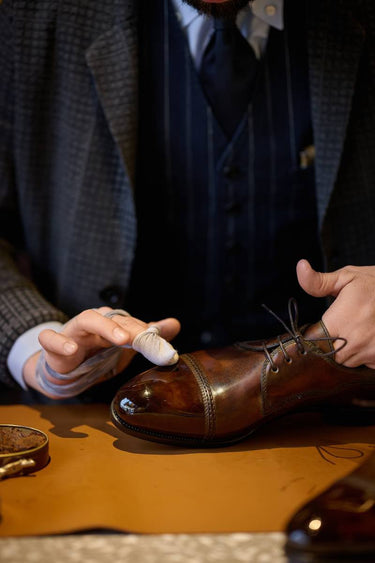
Bontoni’s name has long been synonymous with genuine Italian shoemaking craftsmanship. The Abruzzo-based brand remains steadfast in its commitment to manual labor: each pair of shoes passes through the hands of expert artisans who follow time-honored methods, using only the finest materials. In an era of mass production, Bontoni’s emphasis on precision, quality, and one-of-a-kind detail stands out. Below, we examine every step that transforms a piece of leather into a perfect pair of shoes.
1. Selecting and Preparing Premium Leathers
The foundation of every Bontoni shoe is a meticulously chosen hide. The brand partners with leading tanneries in Italy and France to source only top-grade full-grain calfskin. For example, the “Quasimodo” Five-Eyelet Split Toe Derby in Brown , available on Sartale, features richly pigmented calfskin that reveals its natural texture and subtle tonal variation. Before cutting begins, artisans thoroughly inspect each hide for strength, consistent thickness, and the absence of flaws.
Once a hide is approved, it is spread, flattened, and any small wrinkles are removed. Skilled craftsmen then mark pattern outlines by hand, ensuring that the grain direction aligns perfectly across both the vamp and the quarters. This initial step guarantees symmetry and a precise fit—essential elements of bespoke-level footwear.
2. Hand-Cutting and Skiving Edges
After preparation, pattern pieces are laid onto the leather and cut by hand with precision knives. This process demands a steady hand and deep knowledge of the material’s behavior—any slight error can create misaligned grain or uneven edges. Bontoni cutters use a combination of traditional French paring knives and specially forged Italian blades to achieve ultra-thin, skived edges on each upper component—a crucial technique that allows stitching to remain virtually invisible from the outside.
For example, the “Libertino no Fiore” Oxford in Black features hand-perforated medallion motifs along the toe cap. Each punch is made individually at consistent intervals, underscoring Bontoni’s commitment to uniformity. The edges of the toe cap, quarters, and heel counter are exceptionally skived, so that when sewn by hand, the seams lie nearly flat and unseen on the exterior.
3. Hand-Lasting: Shaping the Upper by Hand
One of Bontoni’s most revered techniques is hand-lasting. Rather than relying on machine tacks, artisans use small brass tacks and their fingers to gently stretch and mold the leather over a wooden last, shaped to approximate the natural foot form. Each motion involves pulling the leather little by little, rotating the last to ensure even tension across the entire upper.
Take the “Magnifico Reverse” Loafer with Tassels in Whisky : its vamp and quarters meet seamlessly at the sides, creating a refined silhouette thanks to hours of manual lasting. This painstaking process ensures that, once removed from the last, the shoe retains a structure that closely mimics the wearer’s foot, preventing unsightly creases and maintaining long-term shape retention.
4. Hand-Stitching and Goodyear Construction
Bontoni’s devotion to durability is evident in its use of Goodyear welt construction—a hallmark of high-end shoemaking. Unlike cemented soles or Blake stitching, Goodyear welting requires stitching a leather welt to both the upper and the insole before attaching the outsole. Bontoni artisans stitch the welt by hand using waxed linen thread, placing each delicate stitch around the insole’s perimeter. This technique not only allows for resoling but also creates a tight seal that resists water penetration.
For instance, the “Quasimodo” Derby’s split-toe seam is reinforced internally by a hand-stitched detail that anchors the toe cap, preserving the distinctive vee shape. Each welt stitch is spaced with precision—no two are misaligned—highlighting the craftsman’s skill and patience. After the welt is attached, a strip of leather is hand-stitched to form the welt itself, and the outsole is then adhered and stitched to that welt, producing a robust double-row seam visible along the shoe’s edge.
5. Hand-Finishing and Polishing: Creating a Unique Patina
Perhaps the most visible aspect of Bontoni’s mastery is its final finishing process. Artisans apply multiple layers of cream and wax polishes by hand, using soft cotton cloths and horsehair brushes. Each layer is allowed to partially dry before buffing, resulting in a patina that deepens and becomes richer over time. The “Brera Norvegese” Suede model , for example, receives hand-applied treatments that maintain the nap’s softness while subtly shading the toe and heel.
For calfskin models, the process begins with a neutral leather balm to condition the hide. Next, specialized pigmented creams—often blended in small, bespoke batches—are chosen to match each leather’s unique undertones. Polishing cloths are then used in tight, circular motions to achieve a mirror-like shine on the vamp, while suede finishes rely on repeated brushing to keep the fibers upright. This intricate final step can take over an hour per shoe, highlighting why Bontoni’s footwear carries an artisanal signature that grows more compelling with every wear.
6. Style Descriptions: Integrating Bontoni into Modern Wardrobes
Though craftsmanship is paramount, understanding how to style Bontoni shoes bridges tradition and contemporary fashion. Consider these examples:
-
“Quasimodo” Five-Eyelet Split Toe Derby in Brown: Pair these Derbies with a tailored charcoal flannel suit and a crisp white dress shirt. The split-toe seam adds a subtle visual accent, drawing the eye to a slim pant break above a pebbled calf-leather sole. For casual settings, swap the suit for dark indigo selvedge denim and a navy merino crew-neck sweater—the warm brown tones harmonize with deep indigo to create a refined yet relaxed palette.
-
“Libertino no Fiore” Oxford in Black: These black Oxfords showcase a floral perforation across the toe cap. Wear them with a gray wool pinstripe suit for boardroom-ready polish, where the subtle detailing elevates a conservative ensemble. Off-duty, layer a navy double-breasted blazer over a white Oxford shirt and gray tailored chinos; the Oxfords’ lustrous shine and perforations hint at sartorial sophistication without overpowering the outfit.
-
“Magnifico Reverse” Loafer with Tassels in Whisky: Use these loafers to brighten a spring outfit—pair them with a light beige linen suit and a pastel-blue linen shirt. The Highland roped stitching along the apron introduces texture that echoes the linen’s weave. For autumn, match with olive green corduroys and a camel cashmere turtleneck; the whiskey leather’s depth resonates with fallal hues and elevates relaxed tailoring.
Explore Bontoni’s handcrafted masterpieces on Sartale
Frequently Asked Questions
1. What sets Bontoni’s handcrafted process apart from factory-made shoes?
Bontoni’s handcrafted process encompasses every step: from manual pattern marking and cutting to hand-lasting, stitched Goodyear welts, and multi-layered hand polishing. This ensures a precise fit, impeccable symmetry, and long-lasting durability—qualities unattainable in mass production.
2. How should I care for Bontoni’s leather shoes to preserve their appearance?
Regularly wipe leather with a soft brush or cloth and apply a suitable leather conditioner or balm. Avoid harsh cleaners and use only products designed for fine leathers. Suede models should be lightly brushed with a specialized suede brush and treated with a water-repellent spray as needed.
3. Why does Bontoni choose Goodyear welt construction?
Goodyear welting involves stitching the welt to the upper and insole and then attaching the outsole to the welt. This method provides superior durability, simplifies resoling, and creates a water-resistant seal. The visible welt stitching also adds a classic, refined finish.
4. What materials besides calfskin does Bontoni use?
In addition to premium calfskin, Bontoni artisans work with high-grade suede, mink lining for select luxury models, and, for limited editions, exotic options like crocodile hides to create truly exclusive pieces.
5. How long does it take to produce one pair of Bontoni shoes?
On average, each pair requires 40 to 60 hours of handwork: from selecting and cutting the leather to stitching the welt, lasting, and final polishing. Complex models and specialized finishes can extend the process to several weeks.
6. Which Bontoni styles are currently featured on Sartale?
Sartale’s collection includes the Spring–Summer 2025 lineup, with new variants such as “Quasimodo” Derby in Russet Brown and “Magnifico Reverse” in Navy Blue, among others. The Bontoni section is updated regularly—watch for fresh arrivals and limited editions.
7. How do I determine the correct Bontoni shoe size?
Bontoni generally follows European sizing. Try on shoes in the afternoon when your feet are at their fullest. If you’re between sizes, opt for the larger size or consult Sartale’s customer service for precise measurements and guidance.
Each pair of Bontoni shoes is more than mere footwear—it is a testament to centuries-old traditions, expert craftsmanship, and a passion for perfection. By upholding the values of handmade artistry and individuality, the brand produces shoes that become timeless investments in both style and comfort.