


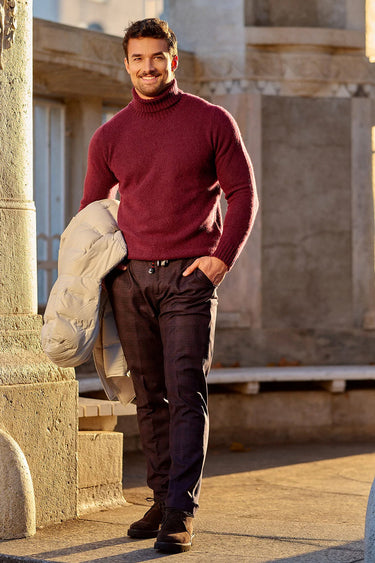
There’s a precise moment every autumn when your usual shirt-and-tie suddenly feels a bit too stiff and a bit too cold. The air bites, the commute gets darker, and you start to wish your tailoring worked as hard as your knitwear. That’s exactly where the turtleneck with suit steps in.
What used to feel like a bold, slightly “editorial” move has quietly become a modern classic. In menswear circles, pairing a roll-neck under blazer or suit is now seen as an easy way to soften strict tailoring and make it work for real life: hybrid offices, smart dinners, winter city breaks.
In this guide, we’ll break down how to wear turtleneck to office, what makes a good fine-gauge turtleneck for sharp outfits, how merino and cashmere behave under tailoring, and why a turtleneck with overcoat might be your most effortless winter move.
Why the turtleneck with suit works right now
A good turtleneck with suit does three useful things at once:
- Softens the formality of a classic business suit
- Adds real, practical warmth without bulky scarves
- Gives your outfits a modern, slightly Continental attitude
Style writers and tailors have been talking about this pairing for a while now, calling it a relaxed alternative to shirt and tie that still feels intentional and polished.
The combination works particularly well in today’s dress codes because:
- Many offices have moved to business casual – the shirt-and-tie “uniform” is no longer mandatory
- Men want fewer, better pieces that can move from office to dinner without an outfit change
- Winter tailoring looks better with texture: flannel suits, wool ties, brushed cotton shirts – and of course, knits
A roll-neck under blazer reads like you’ve thought about your look, but you’re not trying too hard. It’s a subtle signal of confidence: you’re not hiding behind the standard uniform.
Choosing the right fine-gauge turtleneck for tailoring
The biggest mistake men make with turtlenecks and suits is going too chunky. A heavy fisherman knit under a slim lapel will fight the jacket and distort the line of your shoulders.
For tailoring, you want a true fine-gauge turtleneck – the kind that still feels like knitwear, but behaves almost like a base layer. Extra-fine merino or cashmere, knitted fairly close to the body, is ideal.
Fine-gauge vs chunky: what actually changes?
- A fine-gauge turtleneck slides cleanly under a suit jacket without bunching
- The collar sits neatly against your neck, instead of rolling over like a big scarf
- The body of the knit follows your torso, so the jacket can still drape the way the tailor intended
Think of it this way: your fine-gauge turtleneck should feel more like a luxurious second skin than a thick sweater. That’s why extra-fine merino turtleneck styling is so popular – merino regulates temperature, breathes well, and looks sleek in darker shades.
On Sartale, you see this philosophy in pieces like the Barba Napoli virgin wool turtlenecks or the Sease wool roll-necks: refined yarns, clean ribs, no unnecessary volume.
Merino vs cashmere: which turtleneck belongs in your suit rotation?
Both merino and cashmere work beautifully under tailoring – they just play slightly different roles.
Merino turtleneck styling
A merino turtleneck is your everyday workhorse:
- Naturally breathable, so you don’t overheat in meetings or on the commute
- Springy and resilient – it keeps its shape even after a long day under a jacket
- Often a touch crisper, which reads sharp and businesslike
A navy or charcoal fine-gauge merino turtleneck is the cleanest starting point if you’re new to the look. It pairs with almost any grey or navy suit, and also works under a casual blazer on denim days.
Cashmere turtleneck business casual
Cashmere is where things become interesting. Cashmere turtleneck business casual outfits are about quiet luxury – that sense that you’ve chosen something soft and indulgent, but not showy.
Cashmere turtlenecks, like the Malo cashmere styles you’ll find at Sartale, offer
- Exceptional softness around the neck (vital if you’re sensitive to wool)
- A subtle, elegant sheen that looks elevated under sharp lapels
- Warmth with very little bulk – perfect under slim-cut suits
Reach for cashmere when you want your turtleneck with suit to feel more like a statement: dates, winter weddings, evening events, or simply those days when you want your outfit to feel special.
How to wear turtleneck to office without overthinking it
Office dress codes can be confusing. The good news is that a turtleneck with suit actually simplifies things – it reduces visual noise and makes your outfit feel intentional.
Safe office combinations
For most professional environments, stay with clean, minimal palettes and fine textures:
- Mid-grey flannel suit + navy fine-gauge turtleneck + black Oxford shoes
- Navy hopsack blazer + charcoal roll-neck + grey tailored trousers
- Soft brown suit + milk-white or stone merino turtleneck + dark brown loafers
If your office leans more conservative, treat the turtleneck as a seasonal replacement for a shirt and tie, not as an excuse to go bold everywhere else. Keep:
- Colours deep and neutral
- Patterns quiet (plain suit or very subtle check)
- Footwear classic – oxfords, derbies, loafers
The goal is to look like you understand the rules, not like you’re trying to shock HR.
Roll-neck under blazer: the flexible middle ground
You don’t always need a full suit. A roll-neck under blazer is often more useful – especially in modern, hybrid workweeks when you’re moving between office, co-working spaces and travel.
It works best when:
- The blazer has a bit of texture: wool, tweed, herringbone, soft corduroy
- The turtleneck is plain, creating a calm block of colour
- Trousers are tailored but relaxed – think flannel, chinos, or dark denim
For example:
- Navy textured blazer + dark chocolate roll-neck + grey flannel trousers
- Soft taupe blazer + light grey fine-gauge turtleneck + navy chinos
- Charcoal blazer + black roll-neck + black jeans for a sharper, evening-ready look
If you’re working from home but still want to look “client-ready” on screen, this roll-neck under blazer combination reads polished on camera while staying comfortable all day.
Outfit ideas: turtleneck with suit from office to weekend
To make things clearer, here’s a simple overview of how a turtleneck with suit (or just a blazer) can adapt to different situations.
|
Occasion |
Suit / Blazer |
Turtleneck |
Shoes & Extras |
|
Conservative office |
Mid-grey flannel suit |
Navy fine-gauge merino |
Black Oxfords, simple leather belt |
|
Creative office |
Soft brown or olive suit |
Light grey or ecru merino turtleneck |
Brown loafers, textured socks |
|
Dinner / date night |
Charcoal or dark navy suit |
Black cashmere turtleneck |
Polished black derbies, pocket square |
|
Weekend in the city |
Navy blazer, sand chinos |
Mid-grey roll-neck |
White leather sneakers, wool scarf |
|
Travel day |
Unstructured blazer, drawstring wool trousers |
Fine-gauge navy turtleneck |
Suede sneakers, lightweight overcoat |
Use this as a starting point. Swap colours to suit your skin tone and the pieces you already own. The structure stays the same: a calm block of knitwear, a textured jacket, and footwear that matches the level of formality.
Turtleneck with overcoat: winter layering that always looks intentional
Once temperatures drop further, the turtleneck with overcoat becomes your best friend.
A clean roll-neck frames your face, keeps your neck warm without a scarf, and creates a strong vertical line under an open coat. Think of three classic combinations:
- Black turtleneck + charcoal overcoat + grey trousers
- Camel overcoat + cream fine-gauge turtleneck + dark denim
- Navy polo neck + navy or dark olive coat + grey flannel trousers
The key is contrast and texture. A cashmere turtleneck under a brushed wool coat looks rich but effortless. Brands like Sease – whose black wool turtlenecks sit firmly in the “urban performance” space – are a good example of knitwear designed exactly for this kind of city layering.
You can still add a scarf if it’s really cold, but you’re no longer depending on it to protect your neck. That makes the whole silhouette cleaner and more modern.
Fit and proportion: making the combination feel sharp, not sloppy
Even the best merino turtleneck styling can be ruined by poor fit. When you pair a turtleneck with suit, pay attention to three things:
1. Collar height
A mid-height neck is the most versatile. Too low and it looks like a mock neck tee; too high and it starts to bunch or feel costume-like. The collar should sit comfortably halfway up your neck, with no folding needed.
2. Body fit
Aim for:
- Close but not tight through the chest
- Slim sleeves that slide under the jacket without pulling
- A hem that sits around mid-hip and can be lightly tucked if needed
If the knit is too loose, it will bunch around the waist and ruin the clean line of your suit. Too tight, and every movement feels constrained.
3. Suit adjustments
If you plan to wear turtlenecks regularly with a particular suit, mention it to your tailor or alterations specialist. Sometimes:
- Letting the jacket out by a centimetre around the chest
- Adding a touch of room in the sleeves
- Checking that the armhole isn’t overly tight
is enough to let the knit sit comfortably underneath.
Colour and texture: easy combinations that always work
If you keep the structure simple, you can play with colour. Some almost foolproof pairings:
- Navy suit + mid-grey turtleneck – clean, modern, great for first trying the look
- Charcoal suit + black turtleneck – dramatic, city-evening energy
- Brown or tobacco suit + cream or oatmeal turtleneck – warm, relaxed, very Italian
- Mid-grey suit + deep forest green roll-neck – subtle colour, still office-appropriate
When in doubt, mirror the palette that works for your shirts and ties: if you normally wear pale blue shirts, a dusty blue turtleneck can slide into your wardrobe very naturally. If you love brown shoes and belts, earth-toned knits keep everything coherent.
FAQ: Turtleneck with suit
Is a turtleneck with suit appropriate for the office?
In most modern business-casual offices, yes. Choose a fine-gauge turtleneck in a dark, neutral colour and wear it with a simple navy or grey suit and classic shoes. It reads smart and intentional, not casual.
Can I wear a turtleneck and suit to a formal event?
For black-tie events, stick to the dress code. But for smart dinners, winter parties or creative-industry events, a dark suit with a black or deep-colour cashmere turtleneck is a strong, elegant choice.
What colours of turtleneck are the most versatile under tailoring?
If you’re starting from zero, go in this order: navy, charcoal, black, light grey, then cream or oatmeal. After that, you can add one or two accent colours that work with your complexion and favourite suits.
Which fabric is better with suits: merino or cashmere?
Merino is the reliable daily option – breathable, elastic, good for long office days. Cashmere feels more luxurious and is perfect when you want your outfit to feel a touch more special, without shouting about it. Many men end up using merino Monday to Thursday and cashmere on Fridays and weekends.
How do I stop the turtleneck collar from feeling tight?
Look for knits with a bit of natural stretch, a smooth inside finish and a mid-height collar. If you hate anything tight around your neck, try a slightly looser roll-neck that folds softly rather than hugging like a high sports base layer.
Can I wear patterns with a turtleneck and suit?
Absolutely, but choose where the pattern lives. If the suit has a strong check or stripe, keep the turtleneck solid. If the suit is plain, you can experiment with subtle melange or rib textures in the knit. Avoid adding patterned scarves on top – it quickly becomes too busy.
What shoes work best with a turtleneck and suit?
The same shoes you’d wear with a normal suit: Oxfords, derbies, loafers, Chelsea boots. For more relaxed turtleneck with overcoat looks, clean, minimal sneakers can also work – especially in a city setting – as long as the rest of the outfit is sharp.
How many turtlenecks do I actually need?
For most men, three to five are enough: two fine-gauge merino turtlenecks in core colours, one lighter neutral (grey or cream), and one or two cashmere or luxury options. If your winters are long, adding a chunky roll-neck for off-duty wear is a smart move.